Trekking Day 1: Stomachache, Fever, and a Forgotten Camera
Once again, a knock on the door woke me up.
Seven in the morning.
I felt a slight unease in my stomach, but I ate breakfast anyway.
Coffee in the morning isn’t bad, I thought. In Japan I never had time in the morning even to boil water (I always got up at the last possible moment).
After eating, I felt stomach pain and rushed to the toilet.
It was loose, but since it was the day of departure, I couldn’t afford to make a fuss.
I bought a raincoat and two pairs of socks at a shop, took a taxi to the bus terminal for the trek, and rode a bus for about two hours to the trailhead.
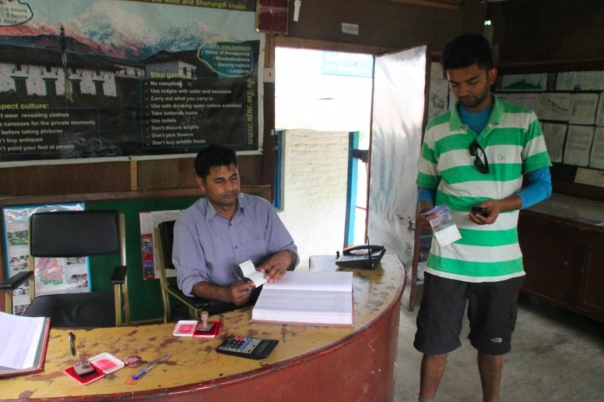
The first entrance is a place called Nayapool.
The elevation here is apparently about 1,000 m.
For the next five days I’d be going to places higher than this, up to 3,400 m at the highest.
I could hardly wait to see how beautiful the scenery would be.
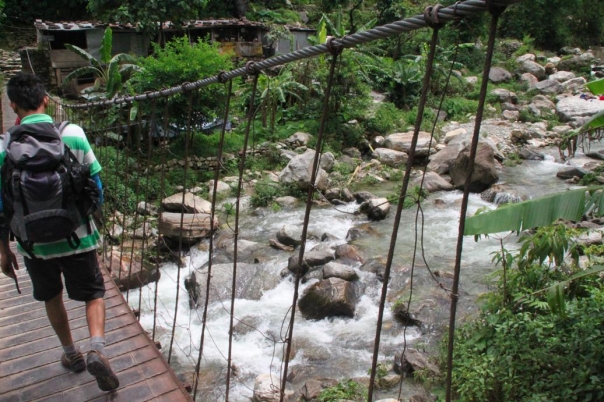
At first the path was very flat. Walking wasn’t hard at all, but I was carrying an 8 kg bag, which felt heavy and made me anxious.
I’d brought a MacBook Air, so I shouldn’t have brought an iPad too. And I shouldn’t have brought six books. I regretted it right away.
I had underestimated trekking. I felt that after climbing a slope for about 30 minutes.
Come to think of it, it was the first time since junior high school that I’d properly climbed a mountain. Around New Year’s this year I walked on Mt. Hanno for about an hour with my two younger brothers, but that probably can’t be called trekking.
Besides the weight of the bag, climbing the slopes was tough.
I rested many times. And, unfortunately, the weather was great, so it was very hot.
I fell into self-doubt: why am I climbing, from day one?
In Shin’ichi Fukuoka’s “Seibutsu to Museibutsu no Aida” (The World Between the Living and the Non-Living), it says, “The minimum condition for being intellectual is whether you can doubt yourself.” This was probably less self-doubt and more whining. Hmm.
During the trek I saw horse dung many times, no, hundreds of times.
I wondered whether it was a living thing, a non-living thing, or something in between.
Life is a system that replicates itself.
That’s what “Seibutsu to Museibutsu no Aida” says. The horse dung itself is non-living, but the many bacteria and fly eggs attached to it are living. That was the conclusion I arrived at.
I kept thinking about such silly things endlessly as I trekked through the first day.
I also asked the guide all sorts of things about Nepal.
That Japanese people only use trekking guides who speak Japanese; trekking in Nepal, its problems and how the system works, the trekking companies’ brokerage fees, a guide’s total pay for the high season, and everything else I could think of.
It was quite interesting.
Three hours after we started walking, the stomachache got worse. I started going to the toilet at every break. Maybe last night’s Nepali dinner didn’t agree with me.
About four hours in, my head started to feel heavy. I had a fever.
After five hours we reached the hotel. It was around 4 p.m.
At that moment I noticed I didn’t have my SLR camera.
I had left it at the place where we rested 30 minutes earlier.
When I told the guide right away, he, seeing my condition, ran off to get it for me.
About 40 minutes later the guide came back with the camera. What a relief.
I thought about giving him a tip, but I didn’t want to set that pattern from day one, so I just kept thanking him over and over.
Relieved, I slept for about three hours, stomachache and all.
I was woken at 7 p.m. and ate dinner.
The stomachache was terrible, and I realized I’d forgotten my Seirogan. Wondering what on earth I had brought on this trek, I took the cold medicine my dad had given me and slept for an hour.
After an hour I felt much better and read a book for about two hours, but then a squall and thunder caused a power outage and I couldn’t read, so I spent about an hour staring blankly at the squall and thunder before going to sleep.
Tomorrow I get up at 7.