May 2016
Why the Inbound Travel Media "MATCHA" Runs a Japanese-Language Site
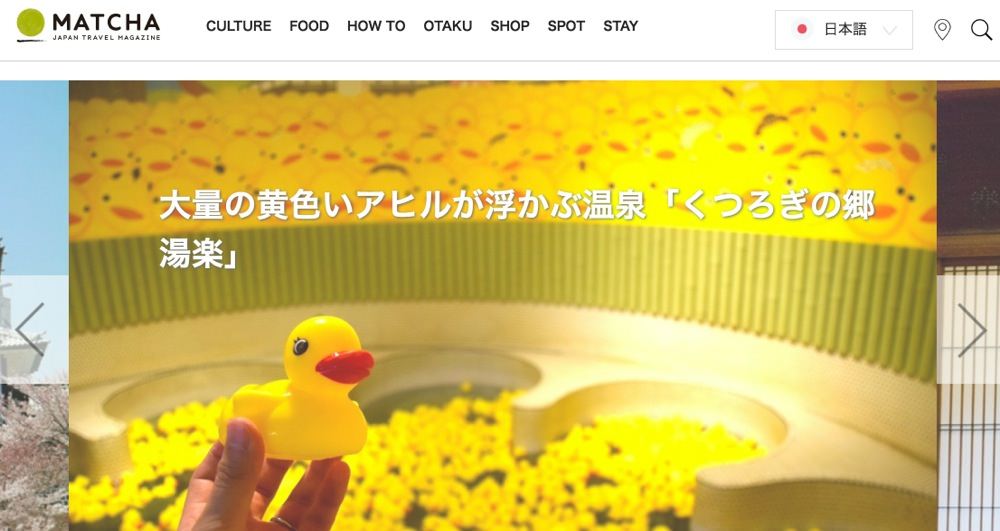
The current top page of the Japanese version.
One thing people often ask me about MATCHA is, “Why do you run a Japanese version?”
I agonized over this quite a bit when I first launched MATCHA. More experienced founders told me many times that I shouldn’t do it. But in the end, I’m glad we did the Japanese version.
I’d like to sum this up once. There are three main reasons.
1. Articles that only people who know the place well can write
The core of a web media outlet is its articles. A media outlet only works if it has good articles. We publish information about regions, and there are articles that only people who truly know the place can write.
If we became a media outlet that originates only in foreign languages, what we could offer would be limited. We would drift away from our aim of sharing and preserving the little-known charms of local Japan.
The difficulty is that precisely because someone knows a place deeply, their expression can become too deep, hard to translate, and hard to convey to other countries. Our writers, editors, and translators work very hard on exactly that.
2. Raising awareness in Japan
With a Japanese version, Japanese people find us through search and social media. In other words, our domestic awareness grows.
What does that bring? People become interested in MATCHA, which becomes an opportunity to gain more colleagues who want to work with us. Many of the people involved with MATCHA today first saw the Japanese version and became interested.
In terms of business, Japanese companies are also our clients, which matters a lot. It makes it easier for them to see how carefully our articles are made, and having Japanese is convenient when they review article drafts.
3. Telling Japanese people, too, what is good about Japan
A behind-the-scenes goal is that I want to convey the good of Japan to Japanese people as well.
I often hear things like “It’s interesting even for Japanese people!” or “I saw MATCHA and went to Wakura Onsen the other day.”
I believe it is Japanese people who most need to know the good of Japan. The same goes for cultural information. For example, “the difference between shrines and temples” or “how to pray at a shrine” are things even Japanese people find themselves thinking, “Wait, what was it again?”
I’d like to properly share things like these, which we vaguely took for granted but never really understood. Given the nature of our company, PR for this has a lower priority, but I think it is important.
That’s my summary of why MATCHA runs a Japanese site.
Running a Japanese version has its pros and cons, but we will continue it and keep working to make it better.
Next, I want to write about wanting to make “a company that keeps receiving job applications from all over the world.”
.