March 2017
Why Don't You Use a Checklist?

Why Don’t You Use a Checklist?
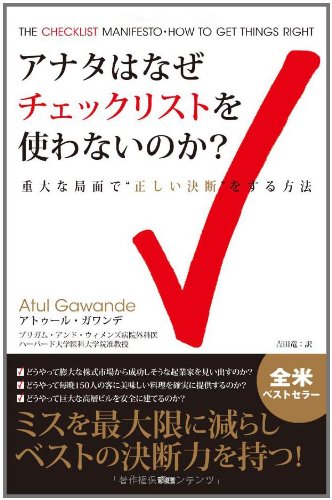
Of the books I’ve read recently, this is the one that impressed me most.
Its content is this: by using checklists, you can reduce mistakes to the absolute minimum, which leads to less anxiety and to greater efficiency and speed.
For example, when an architect builds a skyscraper, it takes an enormous process. Hundreds to thousands of people are involved, building one thing with certainty. Doctors are the same. A single surgery has to go through a variety of steps.
No matter how excellent the architect or the doctor, once in 100 or 1,000 times they may miss some step. That one omission or mistake can lead to a major problem. Checklists prevent it.
Taking doctors as an example, there is a set of steps that must always be followed for infection prevention:
1. Wash hands with soap.
2. Disinfect the patient’s skin with chlorhexidine.
3. Cover the patient with sterile drapes.
4. Put on a mask, a sterile gown, and sterile gloves, and insert the catheter.
5. Cover the insertion site with gauze or the like.
Before the checklist was created, one in three people was skipping one of the steps.
After the checklist was introduced, the infection rate improved from 11% to 0%. By building the task of running through the checklist into the surgical workflow, individual mistakes were dramatically reduced.
Even if a mistake only happens with a probability of 0.1%, when 100,000 people undergo surgery, 100 of them are affected by that mistake.
A checklist for when you arrive at the office in the morning
This applies fully to our own work as well.
There are things we must do routinely. For example, daily information gathering, information sharing, the items to ask in hiring, management… Each of these has fixed steps, and missing even one can lead to a mistake or take far more time than expected.
It’s best to make the things you do every day as efficient as possible, so that you can process them without using your head.
The most effective checklist I’ve made recently is the one for when I arrive at the office in the morning.
I made something like the following.
■ Checklist for when I arrive at the office in the morning
☑ Reply to email
☑ Go back one day in Facebook messages and reply (because once I open them, I often forget to reply)
☑ Reply on Slack and Chatwork
☑ Reply on Wantedly
☑ Gather information
☑ Look through the MATCHA site in all languages
☑ Thinking about the coming week, month, and year, is there anything I should be doing now that I’ve missed?
☑ List and prioritize what to do today
☑ Set and check the agenda for each scheduled meeting
and so on. I aim to get through it all within about 30 minutes.
These may all seem like obvious items, but making this list has made things much easier.
I do these things every morning anyway, but with a checklist, I no longer have to think “what’s next?” I just work through the tasks as “after this, this,” ticking items off, so I’m free from the worry of whether a task is done or not. And there’s a refreshing sense of accomplishment when a task is finished.
This applies not only to morning routines but also to specific tasks you repeat, such as preparing a presentation.
The processes needed to achieve something are the same the first time and the second time. The same goes for presentations. I’ll write about my presentation-prep checklist in the next blog post.
Another good thing about a checklist is that you can copy and paste it, which makes it easy to hand over to others.
So, for anyone who wants to do their work more accurately and efficiently, I truly recommend getting to know this book. I’ve only been using checklists at work for about a month, but my work has become much clearer and easier to move forward.
A book I’d recommend to every working person.
If you enjoyed the above, please check this one out too.
.