April 2017
Why You Should Hire People Who Share Your Vision Over People With Ability
The other day, I had the chance to meet Mr. Fujino of Rheos Capital Works. We’d met at an event in Tokachi, and I was lucky enough to have him look over our business plan.
After a dense hour, I came away with strong confidence and conviction in our business.
At the end, I asked, “What should we be paying attention to at our current phase?” and his answer stuck with me in particular. It was: “It’s better to hire people who strongly share your vision than people who have ability.” I want to write it down on this blog, partly to sort out my own thoughts.
Ability < Vision
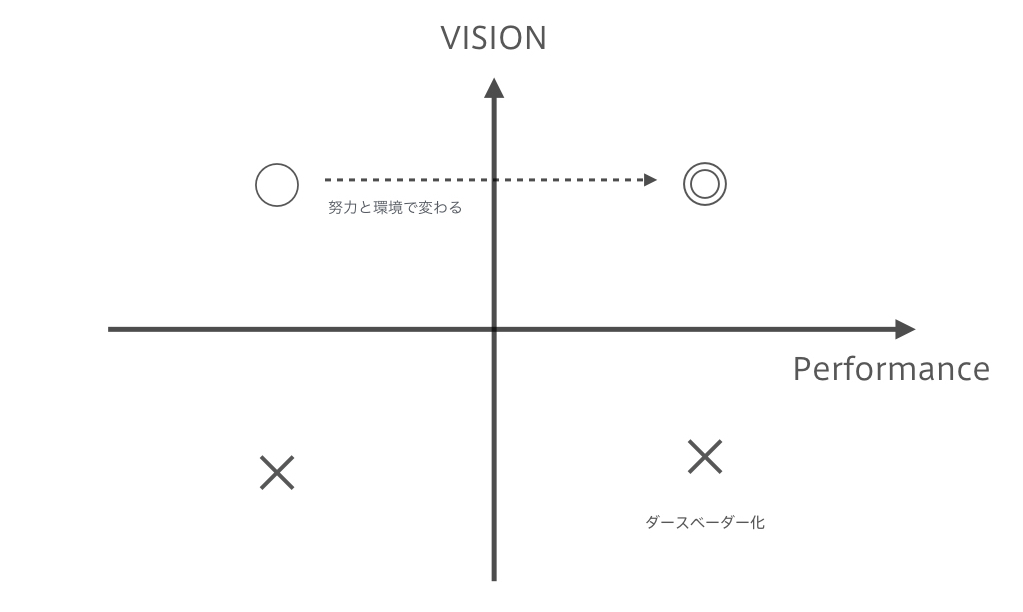
What Mr. Fujino showed me was the diagram above.
The horizontal axis is performance at the company, in other words ability, and the vertical axis is how strongly someone shares the company’s vision.
The person at the lower left, with no ability and no vision, simply isn’t right for the company.
A common trap is hiring the person at the lower right. They have ability, so they deliver some results, but since their direction differs from the company’s vision, they tend to disturb the overall atmosphere and bend things toward themselves.
And gradually they fall to the dark side and turn into Darth Vader, Mr. Fujino said, and from my own past experience I recognized this more than once.
They insist that they’re producing results, but you can’t discuss the fundamentals with them, and it’s hard to move forward as one. Sooner or later they cause some problem and leave the company.
The people to hire are those at the upper right and upper left. The upper-right person has the skills the company needs and also shares the vision strongly. They’re ready to contribute immediately. Honestly, they’re hard to find.
The upper-left person shares the vision strongly, so they can change rapidly depending on their environment and effort.
Depending on the company’s phase, an upper-left person with no experience at all can be hard to hire, for financial reasons or because there’s no environment to train them. One pattern is to join at a phase where a jack-of-all-trades is helpful and gradually come to thrive in the organization on the strength of a particular skill.
Still, I have a feeling that the people who play a central role in an organization over the long term are quite likely to be upper-left people. How a company hires people with potential and builds an environment where they can thrive is probably the key to sustained growth, and I suspect that’s one reason many companies hire new graduates.
As for vision, I also think that almost nobody matches it 100%, and that it rises and falls depending on the company’s environment. The efforts of the representative and the members are essential too.
Hiring is something you can think about endlessly, because an organization is made of people, and that’s the most important thing. Good people produce good services and products, and those eventually turn into money.
I was truly grateful that Mr. Fujino made us rethink the importance of “people,” and I intend to make it one of our key criteria for decisions from now on.
By the way, our company’s vision is “To preserve Japan’s valuable culture along with the times.”
By sharing Japan’s strengths with the world, we want to build a business in which the appeal of Japan’s regions endures while changing.
If that resonates with you, I’d be happy if you’d take a look at the company site.
.