November 2016
University Is a Place to Learn Angles of Approach
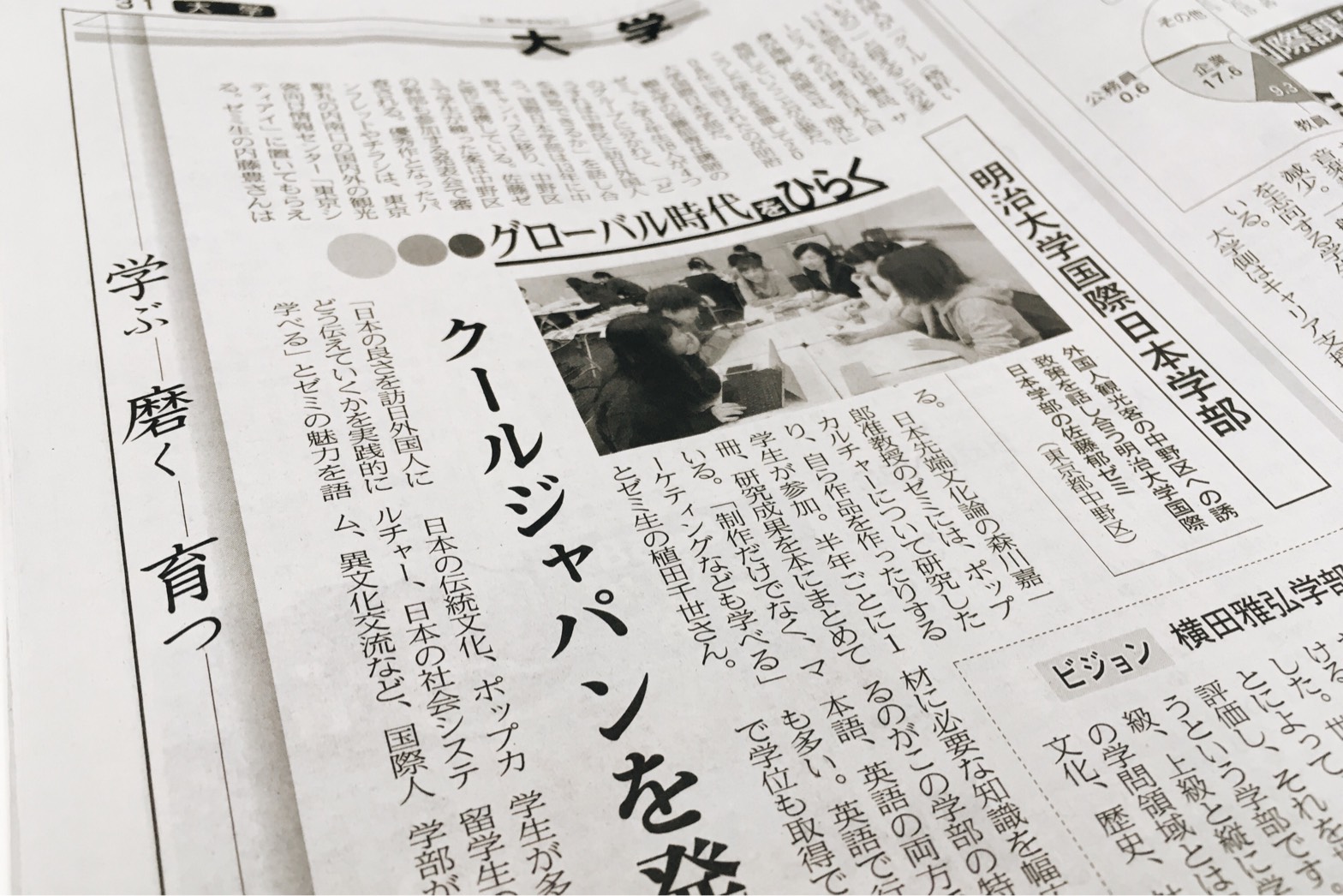
Nikkei Shimbun morning edition, Nov. 9, 2016
The other day, the Nikkei Shimbun interviewed me.
They ran a feature on the School of Global Japanese Studies at Meiji University, and I was featured in the alumni section.
“What kind of school is the School of Global Japanese Studies?”
I was asked that, and I answered:
“A place where Japanese people can learn the angles of approach that matter most for working in Japan from now on.”
At the School of Global Japanese Studies, people who work on the front lines of spreading Japanese culture teach, and there are many interesting classes.
But put another way, I think many of the classes aren’t reproducible.
I don’t mean that in a bad way. I think it’s because the work deals with Japanese culture. (I’ll set aside for now how to define Japanese culture.)
No matter how much you learn inside the university, students can’t become the professors, and what they learn is hard to connect to a job.
In fact, graduates of the school end up in much the same places as graduates of other departments.
The reason is that, frankly, the market in Japan’s cultural field isn’t well established.
The companies and people who truly make a living in this field are limited.
In that case, I believe you have no choice but to move yourself and create the work and the market.
If you grasp the angle that only this school gives you and put it into action, it becomes a strength.
The professors there now also have their current positions and their words precisely because they moved on their own initiative and seized opportunities.
Not just for this school, I think university is a place to learn angles of approach.
You learn an angle at university, then try imitating it. You make it your own and act on it.
As you keep acting, it becomes something you can speak about in your own words. As you put it into words, more people sympathize, and some start to move because of your words and actions.
Before you know it, you’ve drawn people in, and something you couldn’t have done alone takes shape.
That cycle repeats. Beyond it, you begin to see what you truly want to do.
Because what you truly want to do comes not from what you’ve seen or heard, but from what you’ve experienced yourself.
What I want to tell students of the School of Global Japanese Studies is this: find the angle that makes you say “this is it!”, and just move. Put it into practice.
This school has plenty of good material that will be useful in the Japan of the future.
I truly believe that, and it’s a school I’m glad I graduated from.
I want students not just to watch and listen on campus, but to move on their own two feet, grasp experiences that only they can have, and create something new.
.