A Student Traveling the World Joins a 12-Day Vipassana Meditation Retreat in India: No Talking, No Eye Contact, No Reading, Writing or Entertainment.
This article was translated from Japanese. Read the original
Jodhpur, August 5–16
I did a 12-day Vipassana meditation course in Jodhpur, India. On the day it ended, I tweeted about it, and those tweets were compiled into a summary. I’ll use that text and write it all up once more. There are many fragments I couldn’t fit into this blog post, so if you have time, please take a look.
The course I took ran for 12 days, from August 5 to August 16. Talking is allowed on the first day and the last day, the 12th, and the ten days in between, from day 2 through day 11, are the real training period. You sign up for the course online, and I applied two weeks earlier through the Vipassana website in Leh, Ladakh, India. In India, where Vipassana originated, there are meditation centers all over the country, and Japan has two, in Kyoto and Chiba. Vipassana runs on donations, which participants pay after the course ends.
So what exactly is Vipassana meditation? “Vipassana, which means ‘to see things as they really are,’ is one of India’s most ancient techniques of meditation. It was taught in India more than 2,500 years ago as a universal remedy for universal ills, that is, as an ‘art of living.’” So it says. Quoted from the Vipassana website
For the ten days of meditation, all communication is forbidden. That means you can’t speak, make eye contact, or convey anything through gestures. Reading, writing and entertainment are also prohibited, and of course there is no internet or anything like it. Before the course, you have to hand your phone, passport and money over to the center. You can’t leave the grounds during the course. In that space, completely cut off from society, you meditate ten hours a day for ten days.
You meditate with your eyes closed, sitting cross-legged, spine straight, breathing through your nose. There is a five-minute break every hour, and at the start and end of each hour, a recorded lecture plays.
Here is the daily schedule for the ten days.
4:30–6:30 Meditation
6:30–8:00 Breakfast break
8:00–11:00 Meditation
11:00–13:00 Lunch break
13:00–17:00 Meditation
17:00–18:00 Dinner
18:00–19:00 Meditation
19:00–20:30 Lecture
20:30–21:00 Meditation
21:00– Bedtime
The food is vegetarian, with no eggs. There are three meals a day, and you serve yourself as much as you want. You wash your own dishes. The food apparently differs by region, and in Jodhpur, Indian food was served every day. In Kyoto, I hear the brown rice is delicious.
Above I wrote an overview of Vipassana. From here on, I’ll write about what I felt over the ten days, day by day. If the overview made you curious, you might be better off not reading further. The lectures were in English, so I may get things wrong, and since I also write about subjective sensations, it could become a preconception for those who truly want to do the course.
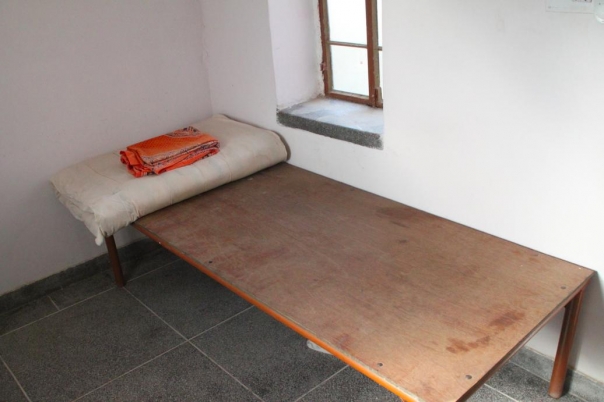
▲ We each got our own room.
Day 1
I arrived at the Vipassana center at 4 p.m. Raymond, from Spain, and I laughed together, saying, “We can’t talk for ten days starting tomorrow, ha ha.” There were six participants: one Spaniard, one Frenchman, me as the one Japanese, and three Indians. There is nothing around the meditation center in Jodhpur. There’s a road, and a car or motorbike passes now and then, but there is no city bustle at all. I laughed inwardly, thinking I’d come to an incredible place. Dinner was at 5 p.m., and after a short rest, all the students were called by the manager at 7 and heard the guidance. After that, we did an hour of sitting meditation and the day was over. “Ah, so the training has begun,” I thought to myself.
Day 2
I woke to the sound of the morning bell, and the ten-day meditation training began in earnest. I got up at 4:30, and after two hours of meditation, the sunrise I saw was beautiful, and chai while watching it was the best. During meditation you sit cross-legged with your posture perfectly straight. I’m usually a sloucher, so I figured it would be painful, but it wasn’t so bad. I thought straightening my back isn’t a bad thing. The lectures were all in English, so it was quite hard, but I got the general meaning. “Just observe objectively.” During the latter meditation of the day, I was struck by a sensation unlike anything before, but I can’t put it into words. When students pass each other, there are no words. You can’t make eye contact, so you don’t even see faces. No communication. You just walk, feeling the other person’s presence. At night my thoughts became so active that I couldn’t sleep for about two hours.
Day 3
Observe the breath at the center of your nose. That was all I was told that day. The strange sensation from the day before had begun to last longer. A feeling of something flowing out forcefully from deep in my chest. It wasn’t unpleasant; if anything, it was comfortable.
Day 4
Straighten your back, close your eyes, breathe through your nose, don’t move your body. That’s what we were told. My legs and lower back started to hurt a little, but when I concentrated and that sensation came, I stopped feeling the pain.
Day 5
By this time, even the times I went to the toilet were exactly the same every day. One hour began to feel like two or three. It’s like when you’re at a boring part-time job and you look at the clock and only five minutes have passed, but it wasn’t sluggish like that; every single minute was condensed in my head. My thinking took leaps, interesting ideas kept coming one after another, and the things I wanted to do kept multiplying. It felt like pieces of information multiplied against each other and shot off. My thoughts were put into words in a way that was almost amusing.
Days 6 to 8
The peak of fatigue began to arrive. Until the day before, sitting for an hour had been easy, but by now even concentrating for an hour was hard. We were told to feel the flow from the top of the head to the tips of the toes, and gradually I came to grasp the flow in the core of my body.
Day 9
The sensation of meditation changed dramatically. I became able to shift into that sensation just by sitting and concentrating on my breath. During the last meditation that night, for a moment I didn’t even know where I was.
Day 10
It was one day before the end, but I approached it as if it were the last day. I tried to move my body as little as possible and concentrated on my breathing and the flow in my body.
Day 11
The Vipassana ten-day course ended in the afternoon of day 11. I’d worried whether I would be able to talk well afterward, but it was no problem. The students who had finished all had great faces, probably from the sense of release. I was smiling so much it was almost creepy. We talked about everything, starting with the meditation. Maybe because we’d lived the same way for ten days and gone through the same unusual experience, we became friends right away. It sounds obvious, but we’d been together for ten days and knew nothing about each other. Precisely because we didn’t know, we wanted to know about each other.
Day 12
I woke at 4:30 in the morning, watched a one-hour lecture DVD, and then meditated for an hour. It was the last meditation at this center. I directed all my nerves into the meditation. I could feel the flow through my whole body. The comfort was greater than ever, fitting for the last session. After the meditation, the manager said, “At 7 o’clock, you are free.” Hearing that, I felt a kind of loneliness. The manager seemed a little lonely too. Around 9 that day, we left the Vipassana center in Jodhpur.
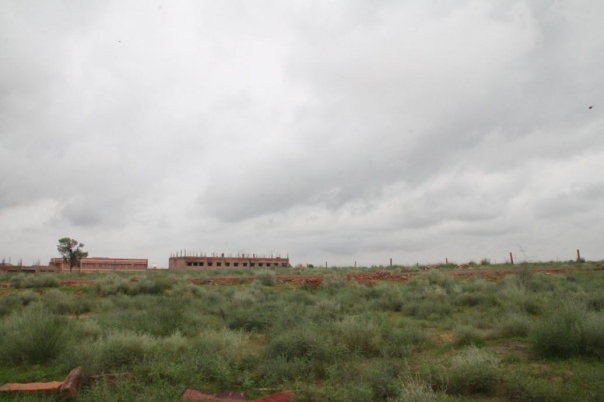
▲ There’s nothing here. A car passes now and then.
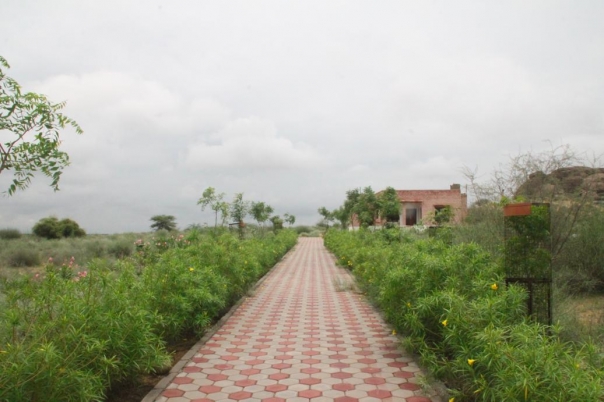
▲ I walked back and forth along this road while brushing my teeth.
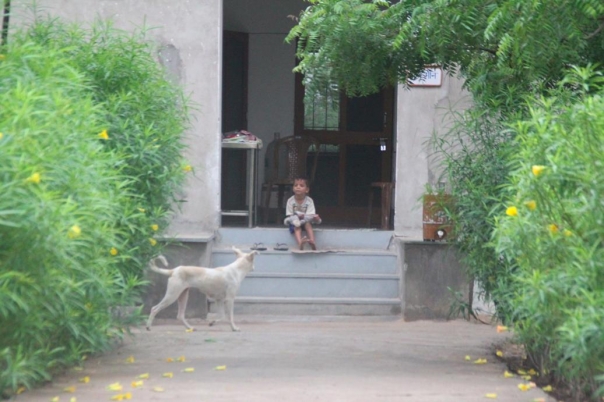
▲ During meditation, I couldn’t talk to this kid or make eye contact either. Of course, the same goes for the dog.
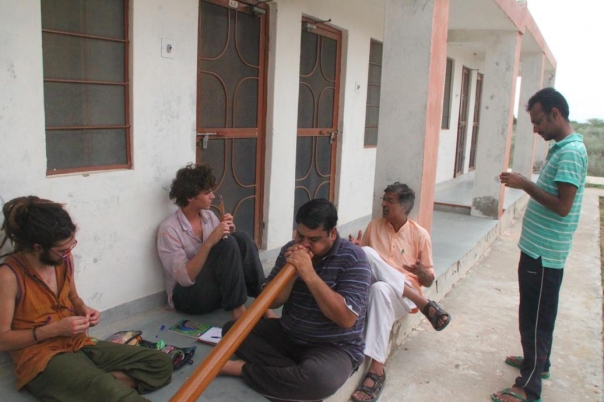
▲ A photo after it ended.
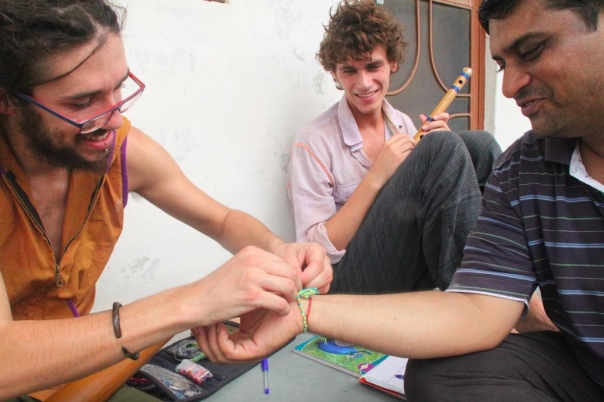
▲ Present for you
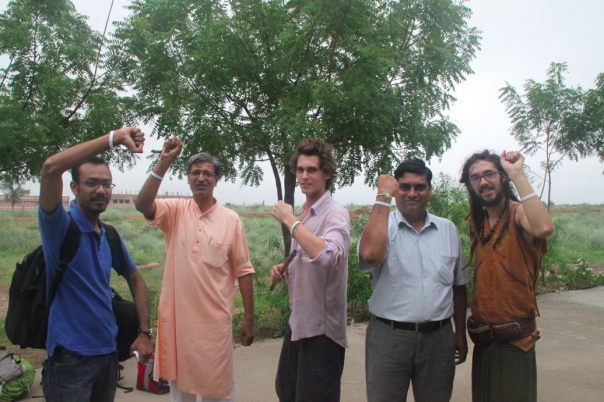
▲ I present TSUMUGI BAND for them.
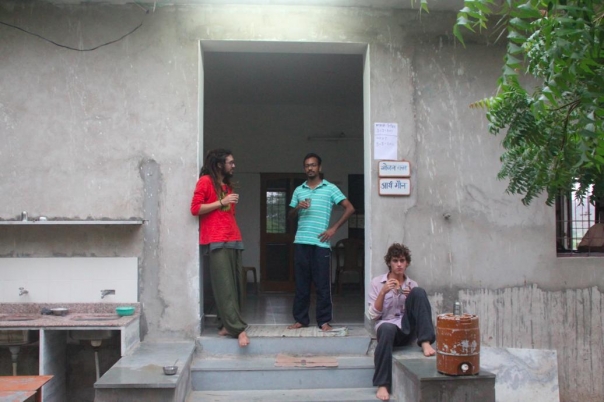
▲ Full of a sense of release.
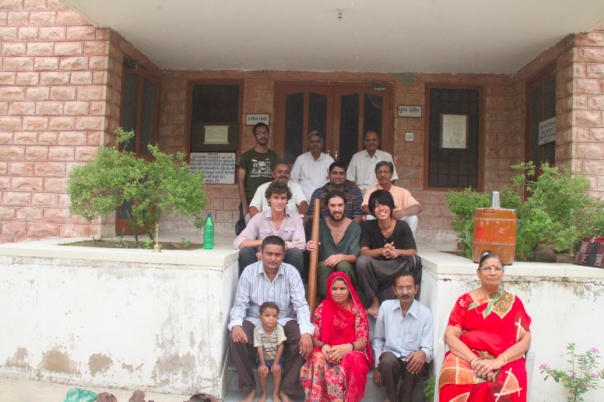
▲ The final group photo. I didn’t take it myself and it’s a little off-center, but I love it.
What I Think Two Weeks After Finishing Vipassana
I got a good weapon. If you asked me to sum up this meditation in one sentence, that’s what I’d say. Frankly, half a month is extremely precious for this short trip of mine. It’s enough time to fully enjoy a whole country. But I really wanted to do this meditation. The moment I learned about Vipassana, where you look at yourself and empty your mind in a space cut off from society, with no communication and no entertainment at all, I wanted to try it.
I thought it was the perfect place to look back on my own life, and I intuitively felt it would be a very good opportunity to think about my future. Above all, I wanted to touch this world. Honestly, it was hard both mentally and physically during meditation. But what it contained and what I gained exceeded my expectations. Travel is a great chance to feel the extraordinary, but I truly believe Vipassana meditation is a chance to feel something beyond the extraordinary.
“Humans live in a highly socialized way, so unless we spend a certain amount of time cut off from relationships and outside stimulation, I think we can’t perceive our raw selves.” A close friend tweeted something like this. I think so too. In daily life, we come into contact with new information whether we like it or not, and we take it in. That’s true of information from people, books and the internet, and even just walking down the street, we’re unconsciously exposed to all kinds of information. When you shut that out, your attention turns to things you normally don’t notice or pay attention to. Through this meditation, I felt that looking back at yourself once, starting from a zero self, is a very important act.
In any case, it was a wonderful experience, and I’d like to recommend it to many people, with the one caveat: it’s not easy. I intend to keep meditating in daily life. And five or ten years from now, at some turning point, I’d like to jump into a Vipassana course again.
▼ Written for backpackers and people who want to try traveling alone!
https://www.aokiu.com/2012/06/21/firstbackpack/For Those Who Want to Travel Abroad Alone! A Beginner’s Backpacker Guide by Someone Who Has Traveled Around the World | Hibilog