Fares Cut by More Than Half! A Roundup of the Budget Airlines Flying To and From Japan

In recent years, LCCs have been increasing in Japan too. LCC (low-cost carrier) means a budget airline (or its tickets), and they have been widespread in Europe, the US and elsewhere for a long time. For example, you can get from London to Barcelona in Spain for around 3,000 yen. Occasionally there are even promotions where you only pay the fuel surcharge.
Cheap tickets like these are now increasing in Japan, too. Compared with conventional tickets from JAL or ANA, every one of them costs less than half. In this entry, I’ll round up the budget airlines that have taken hold in Japan and write down what I think about it.
JetStar
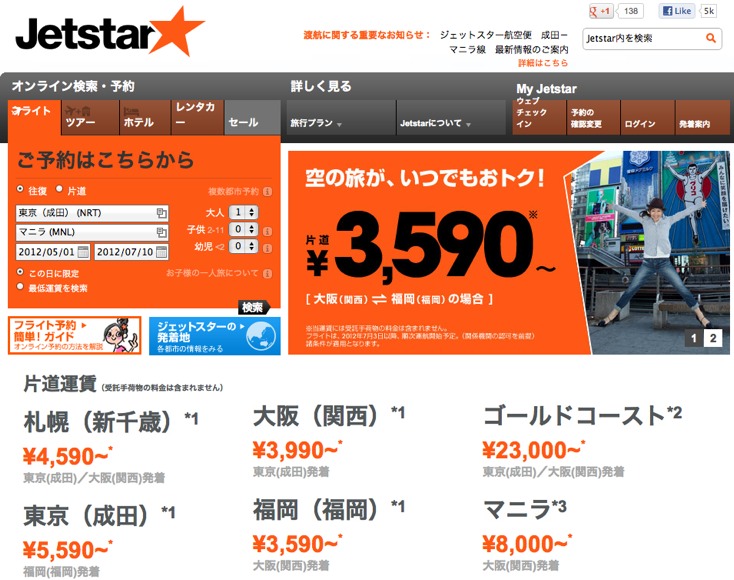
If you’re talking about the one getting attention lately, it’s JetStar. You can reportedly go from Narita to Fukuoka for 5,590 yen, or from Osaka to Manila in the Philippines for 8,000 yen. It’s an Australian airline that entered the Japanese market this year. I’m thinking of using JetStar to go to Okinawa this summer. Having to get all the way out to Narita is a hassle, though.
Spring Airlines
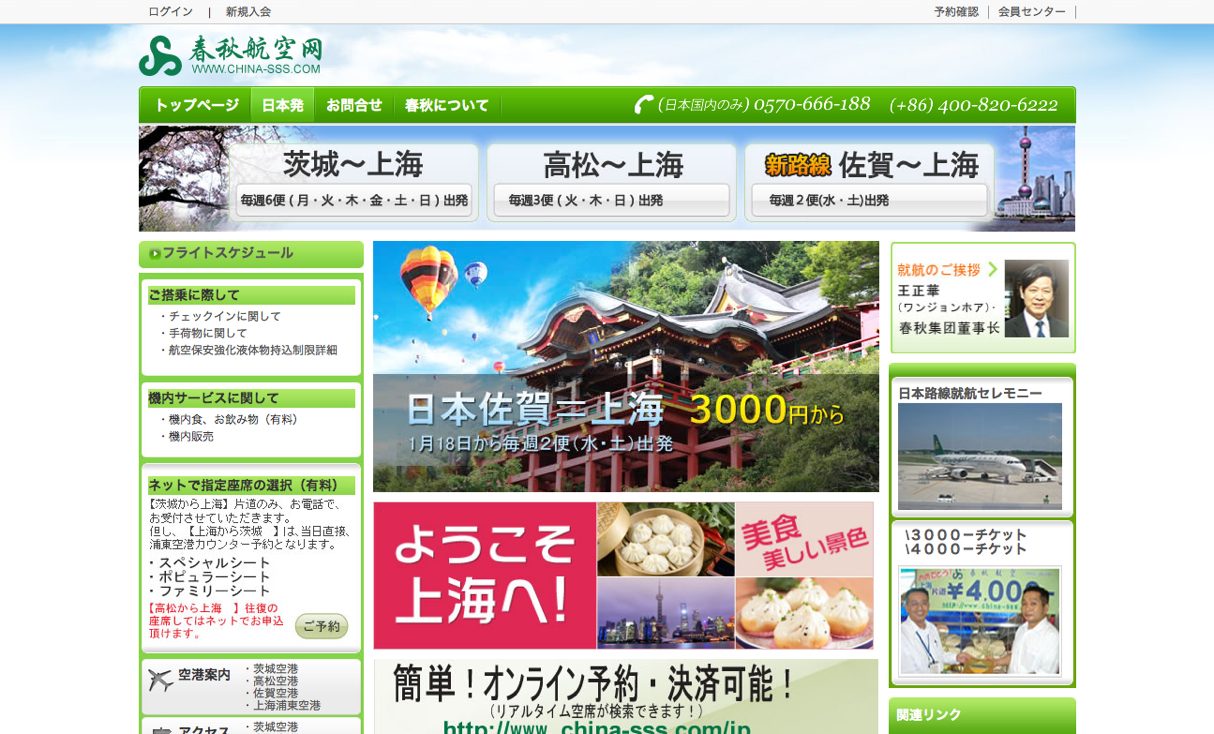
An airline that connects the airports of Ibaraki and Takamatsu with Shanghai. Fares start from 5,000 yen. You can get to Ibaraki Airport from Tokyo Station by shuttle bus for 500 yen, so it’s even cheaper than going from Tokyo to Narita. I plan to use it when I go to Shanghai at the end of this month. Here is the site for the shuttle bus between Tokyo Station and Ibaraki Airport.
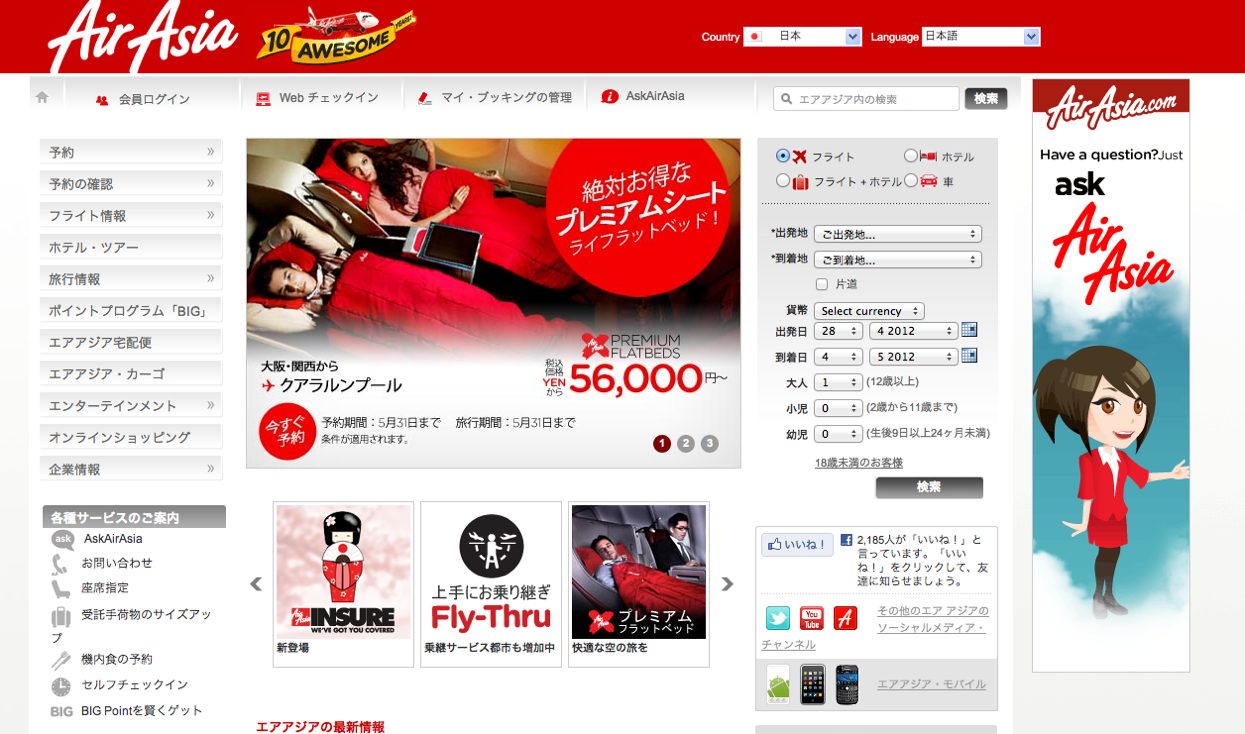
AirAsia
An LCC that flies to many destinations from Haneda and Kansai. From Japan you can go to Thailand, Malaysia, Cambodia, Indonesia and Singapore. Round trips to Malaysia can be had for a little over 20,000 yen when prices are low. It’s apparently called the champion of Asian LCCs. For Tokyo, it flies out of Haneda, so it’s nice and easy to get to.
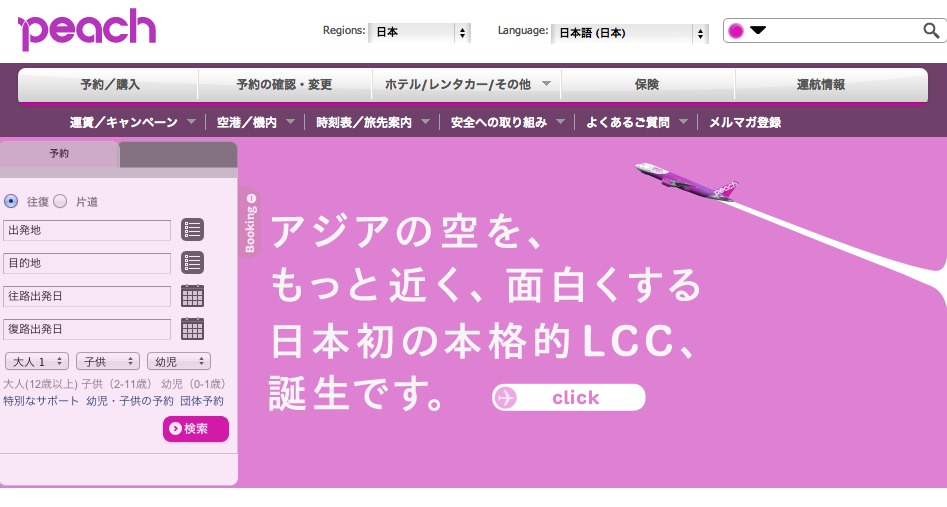
Peach
Peach, Japan’s first full-fledged LCC. In English, “peach” is slang for a cute girl’s bottom, which apparently amuses foreigners. Anyway, Peach, the country’s first LCC, is distinctive in being based in Osaka. It flies several times a day to Sapporo/New Chitose, Fukuoka, Nagasaki and Kagoshima. Its prices are on the slightly high side for an LCC, but compared with the Shinkansen it’s far cheaper.
There are other LCCs too, but many of them are expensive despite carrying the LCC name. I’ll just leave a link here.
About LCC service
Because LCCs cut costs relentlessly, their service isn’t extensive. In-flight meals usually cost extra, and you often have to pay even to choose a window seat. From my own experience, I have never felt that LCC service was bad, or that I never wanted to fly one again. It can be a bit cramped, and the aisles can be narrow, but I’ve never found it a real problem as a passenger. As for the safety question people worry about, airplanes are said to have safety standards incomparably stricter than buses.
Combining LCCs cleverly saves money
Combining LCCs can sometimes get you to other countries more cheaply than a direct flight. For example, on AirAsia, Kuala Lumpur, Malaysia to Cambodia costs only 3,000 to 6,000 yen. Flights from Japan to abroad are often expensive, while flights from one foreign country to another are not so much. If you have time and want to visit many countries cheaply, I recommend leaving Japan for a nearby country first.
For leaving Japan right now, I think Spring Airlines from Ibaraki to Shanghai (from 5,000 yen), Japan to Kuala Lumpur (10,000 to 20,000 yen), and Japan to Manila (from 8,000 yen) are probably quite cheap. Why not try combining them in various ways?
Will miles disappear?
With LCCs this widespread, buying a ticket for less than half the price on an LCC is overwhelmingly better value than flying expensive carriers like JAL or ANA to collect miles. As LCCs spread further, I think miles will fade in importance, and that within a few years they may disappear altogether.
Miles are hard to understand, and you can’t use them until you’ve accumulated a certain amount. Miles differ by airline, so you end up buying tickets with miles in mind. If LCCs become widespread, thoughts like “JAL is a bit more expensive than ANA, but I’ve been collecting JAL miles…” will disappear.
That means credit cards with miles will decrease. Still, there’s no reason not to use a credit card when traveling abroad. Personally, I recommend the Rakuten Card. I’ve put together must-know information about credit cards in the article below, so please use it as a reference.
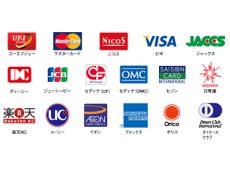
6 Things About Credit Cards You Should Know Before Traveling Abroad
So that was a roundup of the budget airlines that have been increasing for flights to and from Japan, along with what I think about it. LCCs will spread even further in Japan, and I think the flow of things in Japan will change greatly along with them. I’ll keep watching how LCCs develop.
If you found this helpful, I’d be happy if you shared it with a tweet, on Facebook, or on Hatena Bookmark.
.