March 2013
Shouldn't Rural Japan Make Better Use of CouchSurfing and AirBNB?
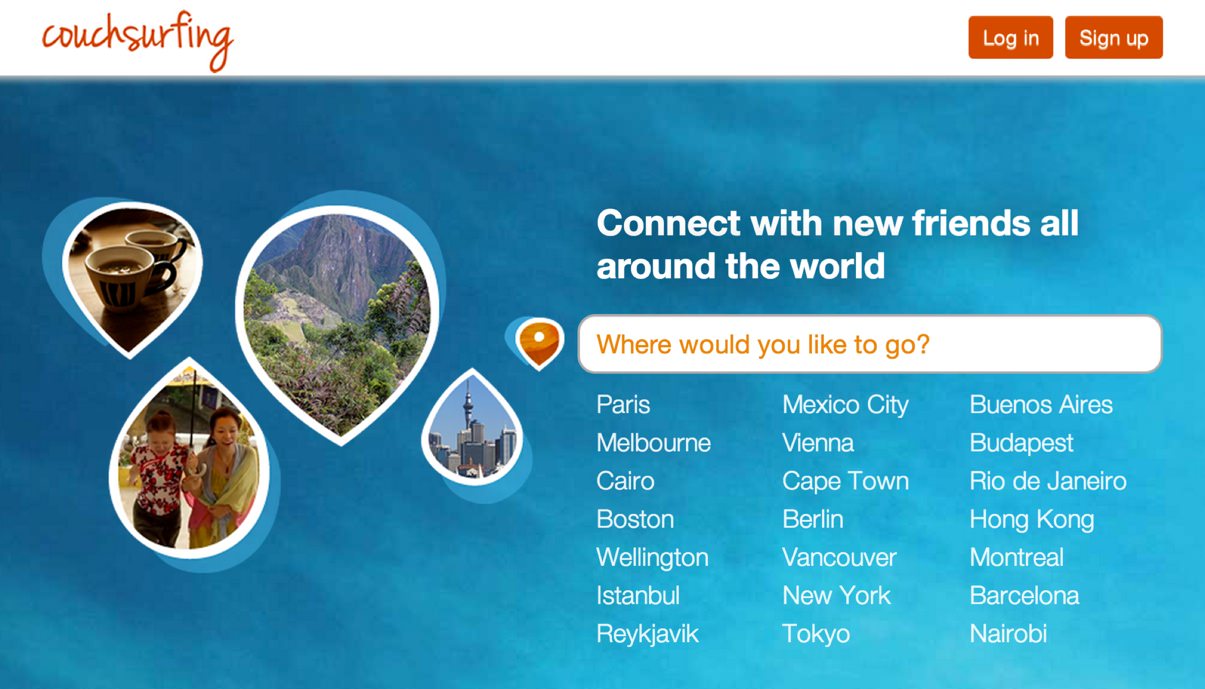
Many travelers now use services like CouchSurfing and AirBNB. CouchSurfing is a service that matches travelers with locals. People registered on CS can message each other, and if the other person is willing, they can share a meal, show you around town, or even let you stay with them.
AirBNB, simply put, is a paid room-rental service. For example, if you have a spare room, you can rent it out for 2,000 yen a night. I’ve never used it, but a friend who lives in Shibuya rented out a room for something like 4,000 yen a night. If rented every day, that’s 120,000 yen a month. Legally it looks pretty shaky. (For the hotel industry, it’s way beyond gray.)
For travelers staying there, both services are good because you can get a feel for everyday life in that country as you travel.
Rural areas, in particular, should make more use of web services.
The other day, when I gave a talk at Kyoiku Gakusha in Wakayama, we got excited discussing these two web services. I think rural areas are exactly the places that should use these services.
In Shingu, Wakayama, there were lots of unused houses and houses whose owners were gone. One person I met was renting an entire house for 2,000 yen a month (!!), which is simply unthinkable in Tokyo. I think cases like this exist not only in Shingu, Wakayama, but in other prefectures too.
I think it would be great to lend those unused houses to foreigners for free through services like Couch Surfing and AirBNB. And not just as individuals, but as organizations or local municipalities. Instead of one house per town, lend 10 or 100 of them.
And rather than just lending them, add a concept: have guests experience farming, like WWOOFing, or invite photographers and videographers to stay and eat for free in exchange for creating works about the town. Hold a competition and have them promote the town. Every town has its own color, and you push that out on the web.
If that works out, I feel it would attract foreign visitors better than getting a few pages in a famous overseas guidebook like Lonely Planet. (Of course, you’d also need rules for vetting people, such as checking references.)
Recently there was the case of the Facebook page for Minamishimabara in Nagasaki (Take our picture! Minamishimabara Contest), which got more than twice the town’s population in likes and doubled annual tourists. I can’t help feeling it was possible because of Nagakawa-san’s experience and sense, but I think it no longer matters whether you’re Tokyo or Kyoto. If you combine something good with the spirit of the times, it can spread without limit.
Travelers’ sources of information are also changing in many ways. The contents of Lonely Planet or Chikyu no Arukikata aren’t necessarily updated every year, and above all, a trip stuck to a guidebook is boring. That’s how my friends and I feel, and foreigners feel the same. Today there was news that TripAdvisor reached 100 million reviews, and I think that number is also proof that the way of traveling is changing.
Spending a lot of money to prepare an environment for welcoming people is important too, but I think what matters more is to build a mechanism that brings people in first, and then develop the environment to match.
When thinking about inbound tourism, what matters is how to get travelers to access information about a town. How to create a flow of information. On top of that, I think rural areas should make more use of places like the web, CS, and AirBNB. That’s what I thought and wrote.
※ When using CS or AirBNB, please watch out for trouble. I hear incidents have happened, especially to women, so please be careful.